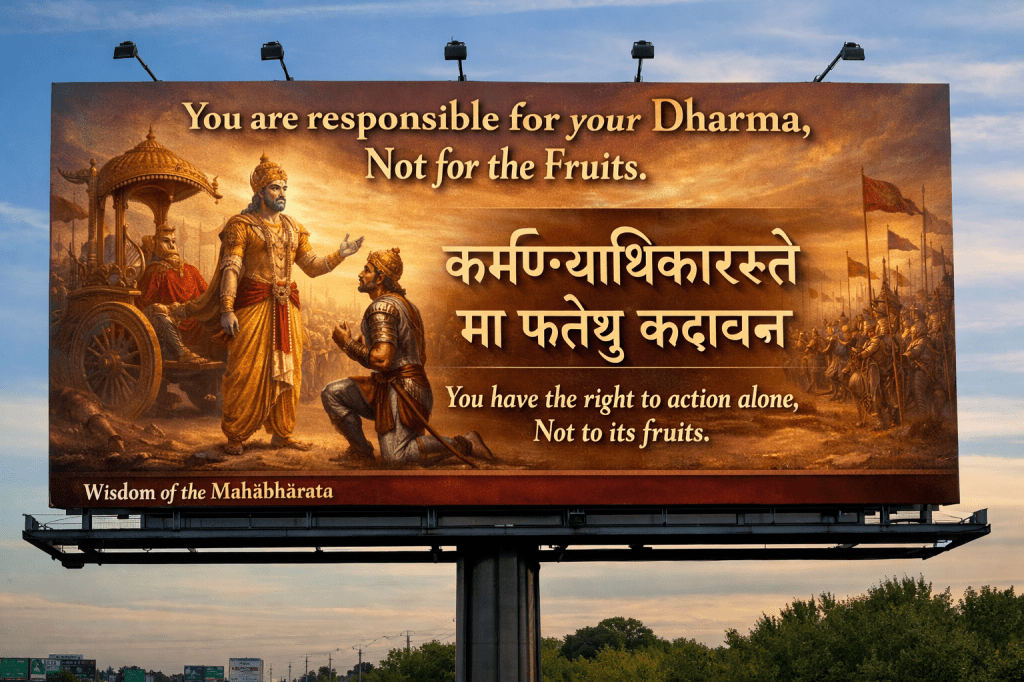
If you had a freeway billboard, what would it say?
Sometimes, it feels as though the entire essence of life is contained within a single verse from the Mahabharata. If we truly absorb and live by this teaching, life may not necessarily become exciting in the way we imagine but it will almost certainly become peaceful.
And over time, I have come to realise something important,peace is not just a necessity, it is a luxury, especially in today’s fast-paced, achievement-driven world.
We live in an era where speed is celebrated, pressure is normalised, and rest is often mistaken for weakness.
For non-Indians, this verse comes from the Bhagavad Gita, a sacred text within the Hindu epic Mahabharata, regarded as a holy book by millions of Hindus. Yet at its core, the Bhagawad Gita is not just religious scripture,it is a guide to practical wisdom, a manual for living life with balance and awareness.
One of its most well-known verses says:
“You have the right to perform your duty,but not to the fruits of your actions.”
This verse teaches that each of us has a role to play,a responsibility shaped by our circumstances, abilities, and inner calling. Our duty is not to control outcomes, but to show up sincerely and act with integrity.
The problem begins when we attach our self-worth, peace, and happiness entirely to results ,success, recognition, timelines, or approval. When outcomes don’t align with expectations, anxiety, disappointment, and exhaustion follow.
Detachment from results doesn’t mean you don’t care.It means doing your part fully, while releasing the mental burden of what you cannot control.
In modern life, we are constantly taught to chase destinations: promotions, milestones, relationships, achievements. But the Bhagavad Gita gently reminds us that the journey itself carries meaning.
When we focus only on where we are going, we often forget to live where we are.This teaching tells us to slow down,not physically, but mentally to experience life as it unfolds, without constant resistance or pressure to “arrive.”
What makes this verse so powerful? That is, it doesn’t promise happiness, success, or certainty. Instead, it offers something far more sustainable: inner peace.And in a world that constantly demands more, peace became the rarest form of wealth.
The Sanskrit Verse at the Heart:
The wisdom I’m referring to comes from Chapter 2, Verse 47 of the Bhagavad Gītā:
कर्मण्येवाधिकारस्ते मा फलेषु कदाचन।
मा कर्मफलहेतुर्भूर्मा ते सङ्गोऽस्त्वकर्मणि॥
Simple meaning:
You have the right to perform your actions,but not to the results of those actions.Do not let the outcome be your motivation,and do not fall into inaction because of fear or attachment.
Have you ever read the Mahabharata or the Bhagavad Gita ? Which verse resonates with you the most, and why?


Your perspective matters! Please share it with me in the comments.