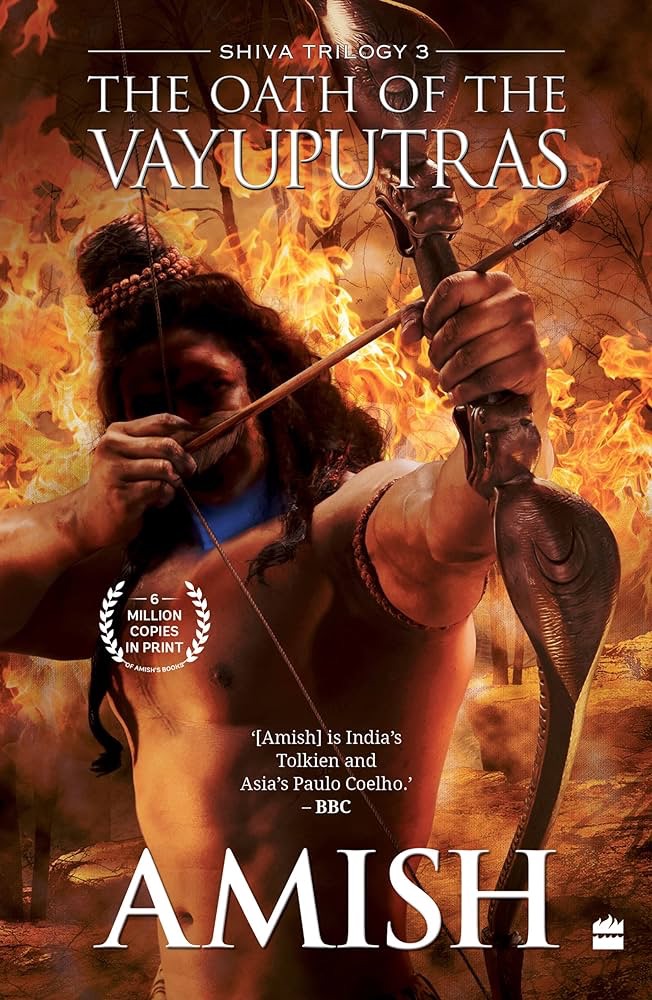
- Number Of Pages: 575 Pages
- Genre Of Book: Fantasy Fiction, Historical Fiction and Novel
“A person rises to greatness not on the wings of dreams but on the wings of sacrifice.”
“Good and evil are two sides of the same coin.What is good for one may be evil for the other.”
I have never read any of the books with this kind of pace. At least not the one that is as lengthy as this one, “The Oath of the Vayuputras”,575 pages just in 3 days. From the series of books, Trilogy 2, “The Secret of Nagas,” captured my mind; the plot was filled up with a variety of emotions, reunion of family, suspense, and drama.
This book is a bit lengthier, but the author is able to cover a lot more aspects of war strategies, geography, beautiful landscapes, and various civilizations. What really amused me is how well Sati’s character is crafted. It has emerged as the best blend of feminine and masculine energies. Her sheer courage, profound knowledge, strategic mind, intellect, and compassionate heart just astonished me. In fact, at some point, I felt as if she was the protagonist of the book. I loved this shift of focus in the character’s limelight. However, what deeply saddened me was her brutal, or perhaps honorable, death. From the warrior’s perspective, it may be seen as a noble sacrifice, but for me, it was heart-wrenching. The scene where she fought like a warrior was so moving that it literally choked me up. I couldn’t help but wish for a different ending,a more positive one as that’s the kind of resolution I always seek, both in life and in fictional stories.
Downfall of Shiva’s character was a little bit upsetting. He was the man of words for all his life and carried himself with utmost grace, morale, and code of conduct. Though that one decision taken in the moment of distress changed all the things, and that one decisive moment, which was very capable and was successful to obliterate his good deeds to a certain extent.
Withstanding this long journey of reading, I just forgot that it is a fictional character. At last, I had to make peace with the fact that he is just a human who lost his love of life and deserves to get vengeance. Being in that kind of pain and fog of grief, it would be really unfair to judge and idolize him up to the extent of perfection.
#shivatrilogy#lovereading ❤️❤️❤️
FAQs:
1. What is The Oath of the Vayuputras about?
It is the final book of the Shiva Trilogy, where Shiva uncovers the ultimate source of evil and must make a devastating choice to restore balance to the world.
2. Who wrote The Oath of the Vayuputras?
The novel is written by Amish Tripathi, one of India’s most popular mythological fiction authors.
3. Is this the last book of the Shiva Trilogy?
Yes. It concludes the trilogy that began with The Immortals of Meluha and The Secret of the Nagas.
4. What does “Vayuputras” mean?
Vayuputras are elite warriors devoted to Lord Shiva, representing discipline, sacrifice, and unwavering commitment to dharma.
5. What are the main themes of the book?
Dharma, sacrifice, justice, moral responsibility, the cost of power, and the consequences of one’s actions.
6. Does the book contain major emotional moments?
Yes. It is the most emotionally intense book of the trilogy, dealing with loss, grief, and difficult moral decisions.
7. How does Shiva’s character evolve in this book?
Shiva matures into a decisive leader who understands that being a savior often requires painful sacrifices.
8. Is the ending satisfying?
The ending is powerful and thought-provoking, bringing closure to the trilogy while leaving readers reflecting on morality and balance.

Amish’s journey as an author began with his first novel, The Immortals of Meluha (2010), the first book in the Shiva Trilogy. Initially, the book was rejected by several publishers, prompting him to self-publish. To everyone’s surprise, it became a massive success, turning Amish into a literary phenomenon. The Shiva Trilogy was India’s fastest-selling book series at the time, selling over 4 million copies.
His second series, the Ram Chandra Series, is an exploration of the Ramayana through different perspectives, blending mythology with Amish’s own interpretation of ancient values.
Writing Style and Themes:
Amish’s novels are celebrated for their ability to weave together mythological tales with modern philosophy, making ancient Indian stories accessible and relatable to contemporary readers. He believes in reviving India’s rich cultural heritage and presents his stories in a unique, grounded manner, portraying gods and mythological figures as humans with flaws and moral dilemmas.
Other Work and Influence:
Amish also engages in non-fiction, with Immortal India (2017) being a collection of his essays on contemporary issues, spirituality, and history. He is an advocate for a balanced understanding of India’s ancient traditions, often drawing attention to the progressive aspects of Indian civilization.
From My Gallery
Other Books from Author


Your perspective matters! Please share it with me in the comments.