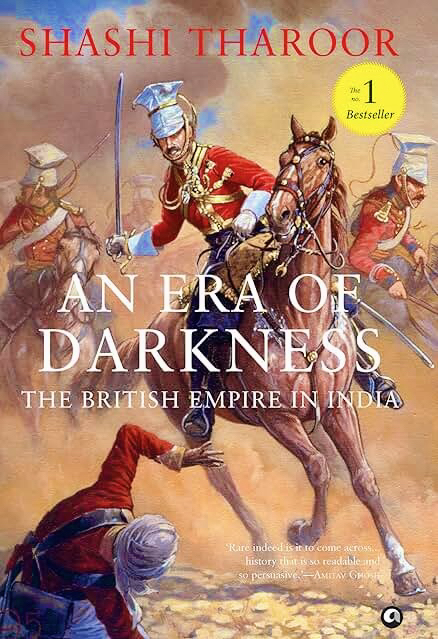
- Number Of Pages: 360 Pages
- Genre Of Book: Non-Fiction
- Published On: 27 November 2016
- Awards: Sahitya Akademi Award 2019
“The British conquest of India was not the benign civilizing mission that so many British politicians and historians would have us believe; it was in fact a monstrous crime, the devouring of a vast and rich land by a rapacious alien power”
It was the prolonged reading book. The toughest ever since I had to refer to the dictionary almost after reading every other sentence, but it was worth reading. The author has been very precise about the message he wants to pass, and the facts and figures are really impressive.
An Era of Darkness -rightly titled and rewarded by the Sahitya Akademi Award. It is the case of a vast, mighty, brilliantly organized, culturally unified, magnificent empire. The case of the richest nation, which was oppressed and looted brutally for almost 200 years and left to drop its global economy share from 23% to 3%. It is a feeling of devastation to read how one of the most diversified countries was torn apart into two different nations on the basis of religion.
The book is partly inspired by one of Shashi Tharoor’s debates at Oxford when he was invited as a speaker at the Oxford Union. It covers all possible impacts that British rule created on India. It broadly uncovers facts about how strategically East India Company looted the mighty empire like India under the name sake of governance. There are many of the events that breaks your heart into pieces from knowing how weavers thumbs were chopped off to destroy the Indian handloom industry in favor of British textile production. The effort to eliminate competition and promote the import of British-made textiles. Indians were kept distant from the accessibility of railways, which were built with their own blood and sweat. The colonial policies prioritized British economic interests over local industries by extracting raw materials from India for British industries, which further ruined the booming Indian steel industry.Indian wheat production was directed towards feeding Britain, especially when India was suffering through famines in Bengal in 1943, where 2 to 3 million people died due to starvation and related diseases. When few British humanes brought this to Winston Churchill’s attention, who served as Prime Minister of the United Kingdom, there was no effort made to solve the problem; instead he made a nasty remark, “Why hasn’t Gandhi died yet?”.
Being a kid, I learned history from an exam standpoint but never understood the impact it had created on our today. But reading this book gave me the heart to appreciate today’s India more than what I used to appreciate it before. It makes me realize how much it would have taken to rebuild the nation, which was ruthlessly damaged from all perspectives whether it is economical, spiritual, or cultural.
I would like to conclude my review with Shashi Tharoor’s saying “ We all know history belongs to the past but understanding it is a duty of present-not to blame British Raj for their wrongdoings but to know where we are heading today. We will never be able to understand where we are going until we know where we are coming from.”
FAQs:
1. What is An Era of Darkness about?
The book exposes the economic, social, and political exploitation of India under British colonial rule and its long-lasting impacts.
2. Who is the author of An Era of Darkness?
It is written by Shashi Tharoor, an Indian politician, diplomat, and acclaimed author.
3. Is An Era of Darkness a history book or political commentary?
It’s a mix of historical analysis and political commentary, supported by detailed research and references.
4. Why is An Era of Darkness important?
It challenges common narratives about British colonialism in India and highlights the scale of exploitation, making it a critical read for understanding modern India.
5. What are the key themes of the book?
Colonial exploitation, economic drain theory, social impact, British policies, and the struggle for India’s independence.
6. Is the book suitable for students?
Yes, it’s useful for students of history, political science, and anyone interested in India’s colonial past.
7. How is the writing style of Shashi Tharoor in this book?
The book is well-researched, articulate, and persuasive, with Tharoor’s trademark eloquence and critical insights.
8. Can this book be read in one sitting?
It’s dense and detailed, so reading in parts is recommended to fully grasp the arguments and historical context.

Shashi Tharoor is an Indian author, politician, and former diplomat known for his eloquent writing and deep engagement with Indian and global issues. Born on July 9, 1956, in London, England, Tharoor was raised in India and completed his education at the University of Delhi and later at the Fletcher School of Law and Diplomacy at Tufts University.
Tharoor began his career in the Indian Foreign Service and served in various capacities at the United Nations, where he gained a reputation for his articulate and informed perspectives on international affairs. He later entered Indian politics and was elected as a Member of Parliament.
As an author, Tharoor has written extensively across genres, including fiction, non-fiction, and historical analysis. His notable works include:• “The Great Indian Novel” (1989) – A satirical retelling of the Mahabharata set against the backdrop of modern Indian politics. • “India: From Midnight to the Millennium” (1997) – An analysis of India’s progress and challenges since independence. • “An Era of Darkness: The British Empire in India” (2016) – A critical examination of British colonialism in India.
From My Gallery

Other Books from Author


Leave a reply to Happy Independence Day, India 🇮🇳 : From Oppression to Opportunity , Why I’m More Proud of India Than Ever – Euphoric Reads Cancel reply